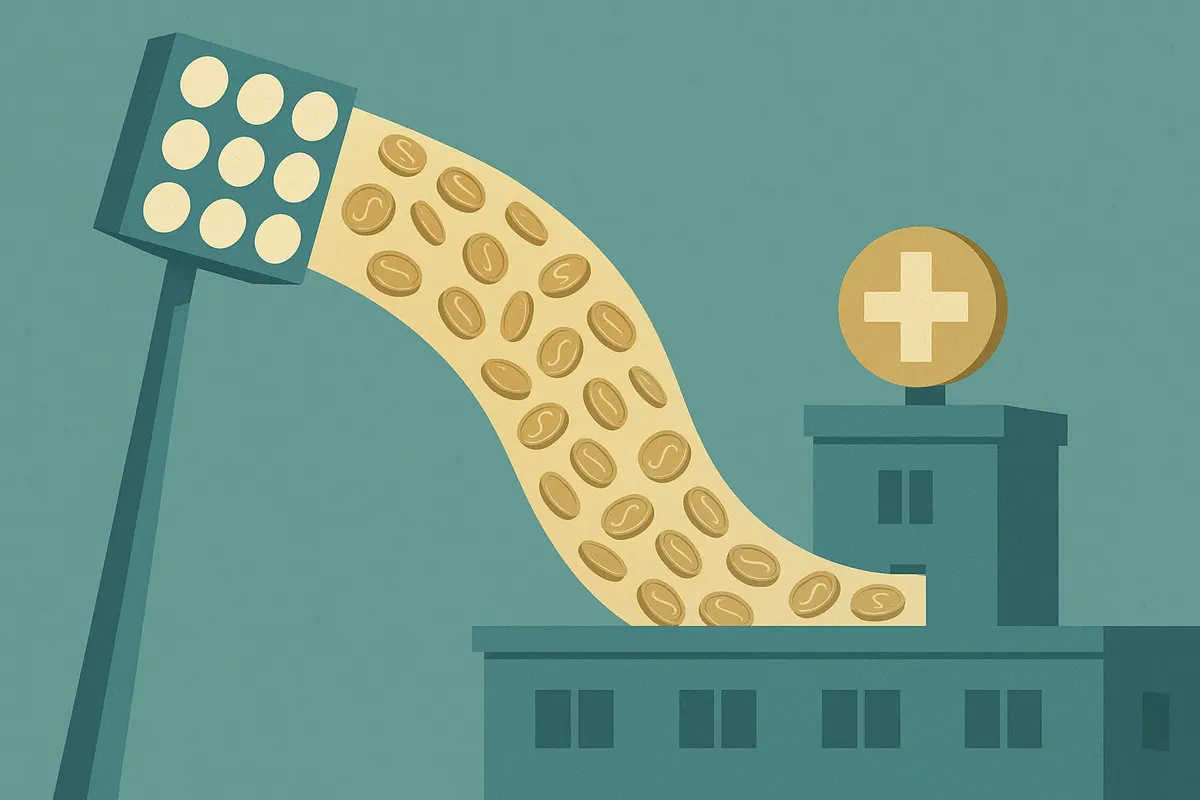
Somebody in Medellín puts a few thousand pesos on a World Cup group game from their phone. They lose. Nothing dramatic happens, no lesson is learned, and the evening continues. But a slice of that stake has already started moving through a licensing system, and by the end of the month it shows up as a line item in Colombia’s subsidised health budget. Multiply that by several million bets and you get the number Coljuegos published for the first eight months of 2026: COP 977.220bn collected for the health system, up 39.38% year on year.
That is the whole story of sports betting tax revenue in one sentence. The interesting part is the plumbing in between, and how much of it a country chooses to show the public.
Colombia’s 39% jump in gambling health collections
Coljuegos, Colombia’s gambling regulator, reported COP 977.220bn in collections for the country’s subsidised health regime between January and August 2026. The comparable figure for the same period in 2025 was COP 701.121bn, so the increase came to COP 276.099bn, or 39.38%.
The regulator put the growth down mainly to sports betting, where collections rose 84.24% as football World Cup activity pulled in more wagering than usual. Online sports betting alone generated COP 473.023bn over the eight months, around 48.4% of everything Coljuegos collected in the period. Work backwards from that 84.24% growth rate and it is clear that betting on sport, not slots or bingo or lotteries, supplied the large majority of the year on year increase.
Two things are worth pausing on. First, “health collections” is not a figure of speech. In Colombia the money raised from licensed gambling is earmarked by law for the health sector rather than dropped into a general pot, which is why the regulator reports it that way. Second, a 39% jump is a reminder that this kind of funding is cyclical. A World Cup year flatters the numbers; the year after it does the opposite. Health budgets built on a tournament calendar have an obvious weakness.
How sports betting tax revenue is collected
Short version: players do not pay the levy at the till. Licensed operators pay it out of what they keep, calculated on a defined tax base, and the regulator or tax authority reports the total.
Tax rate structures: gross gaming revenue vs turnover
Almost every gambling tax in the world sits on one of two bases, and the difference matters more than the headline percentage.
- Gross gaming revenue (GGR) — tax is charged on stakes minus winnings paid out. If a sportsbook takes ₹100 in bets and pays ₹94 back to customers, the tax base is ₹6. This is the most common modern approach, including in Colombia, where online operators pay exploitation rights calculated on gaming revenue.
- Turnover (handle) — tax is charged on every rupee staked, regardless of what the operator keeps. A 2% turnover tax on that same ₹100 book takes ₹2 out of ₹6 of gross revenue, an effective rate of 33%. Turnover taxes look small and bite hard, which is why operators lobby against them and why they tend to push margins, and therefore prices, in the wrong direction for bettors.
Some jurisdictions add a fixed licence fee, an annual administrative charge, or a minimum guaranteed payment on top. Colombia’s model combines licence obligations with revenue-based exploitation rights, so a growing market automatically produces growing collections without anyone changing the rate.
Collection methods: who reports what, and when
The mechanics are deliberately boring, which is the point. A licensed operator files periodic returns declaring stakes, payouts and gross revenue. The regulator reconciles those declarations against data it can see directly, since licensed platforms in most regulated markets are connected to reporting systems that log wagers in something close to real time. Payment follows on a monthly or quarterly cycle, and in an earmarked system like Colombia’s the funds are transferred to the designated health accounts rather than the finance ministry’s general revenue.
Unlicensed offshore sites, by contrast, declare nothing and transfer nothing. That is the quiet argument regulators make for licensing: the betting happens either way, but only one version of it shows up in a public ledger.
Where betting tax public funding ends up
Health services
Colombia is the cleanest example of hypothecation, the practice of legally tying one revenue stream to one spending purpose. Gambling levies feed the subsidised health regime, which covers people who cannot pay contributions themselves. So when Coljuegos announces COP 977.220bn for the period, it is announcing a health input, not a general tax receipt. Roughly half of it, on this year’s figures, came from online sports betting.
Education and sport
Where money is not earmarked for health, education and sport are the usual destinations. Several US states send sports betting tax straight to school funding formulas. Racing and sport bodies in Australia receive a share of wagering taxes and race field fees, on the logic that betting monetises the events those bodies stage. Lotteries around the world have run on this model for decades, funding stadiums, coaching programmes and grassroots facilities.
Problem gambling support
The most defensible allocation is also usually the smallest: funding for research, prevention and treatment of gambling harm. Britain moved this from a voluntary donation system to a statutory levy on licensed operators, with the proceeds directed to research, prevention and treatment. Many US states ring-fence a fixed slice of sports betting tax for problem gambling helplines and counselling.
It is worth being blunt about the trade-off. Public services funded by gambling depend on people losing money, because the house edge is what generates the taxable revenue in the first place. If you bet, treat it as paid entertainment with a negative expected return, set deposit and loss limits, and use self-exclusion tools if the fun stops. Read our responsible gambling guide if any of that sounds relevant to you.
Why transparency in gambling health collections matters
A regulator publishing a number does three useful things at once. It lets the public check that the earmark is real, which is the entire basis of consent for taxing a controversial activity. It gives auditors a baseline to test operator declarations against. And it produces a segment breakdown, so anyone can see what is actually driving growth. Coljuegos did exactly that here by separating online sports betting’s COP 473.023bn from the total and attributing the rise to World Cup activity, rather than leaving readers to guess.
Compare that with a market where betting is unlicensed or barely supervised. There is no collection figure, no segment split, no audit trail, and no way for anyone to argue about allocation because there is nothing published to argue about. Transparency is not a nice-to-have in gambling taxation; it is the only reason the numbers can be trusted at all.
How other markets split sports betting tax revenue
Approaches differ sharply, both in how much is taken and in whether the money is tied to anything. Rates change at budgets and legislative sessions, so treat these as the shape of each system rather than a live rate card.
| Market | Tax base | Approach | Where the money goes |
|---|---|---|---|
| Colombia | Gaming revenue (exploitation rights) | Hypothecated | Subsidised health regime, reported monthly by Coljuegos |
| United Kingdom | Gross gambling yield | General taxation, plus a separate statutory levy | Treasury general spending; levy funds gambling research, prevention and treatment |
| Australia (states) | Net wagering revenue, point of consumption | Partly hypothecated | State general revenue with a share directed to racing and sport |
| New York (US) | Gross gaming revenue from mobile sports betting | Hypothecated, high rate | Predominantly education, with allocations for youth sport and problem gambling |
| Colorado (US) | Net sports betting proceeds | Hypothecated to a single project | State water plan, plus a problem gambling allocation |
Colorado is the odd one out in a useful way. It shows that hypothecation is a political choice rather than a natural law: betting tax funds drinking water there and hospital care in Colombia, and neither link has anything to do with gambling itself.
For Indian readers the flow looks different again, because the tax lands mostly on the player and the transaction rather than on an operator’s declared gaming revenue. Net winnings from online games attract TDS at 30% under the current income tax rules, and GST applies to online money gaming at 28%. Those receipts go into general revenue, so there is no Indian equivalent of a published “health collections” figure to track. If you are working out what you owe, start with our guide to betting taxes in India and confirm the current position with a tax professional.
Frequently asked questions
How much tax do betting companies pay?
It depends entirely on the base and the jurisdiction. Rates on gross gaming revenue commonly run from single digits to well over 40% in the highest-taxing US states, while turnover taxes of 1% to 2% can translate into effective rates above 30% of gross revenue. Licence fees and administrative charges sit on top.
What percentage of betting goes to health?
There is no universal share. In Colombia, gambling levies are legally directed to the subsidised health system, which is why Coljuegos reports a health collections figure at all, and online sports betting made up about 48.4% of that COP 977.220bn total through August 2026. In most other markets gambling tax goes into general revenue and health gets no ring-fenced slice.
How are sports betting taxes actually used?
Either as general government spending or as earmarked funding for a named purpose: health, schools, sports development, water infrastructure, and gambling harm research and treatment. The earmark is set in legislation, not decided by the regulator.
Does a big collection increase mean the market is healthy?
Not necessarily. Colombia’s 39.38% rise was driven by a World Cup, which is a one-off spike in activity rather than structural growth. A regulator can also raise more money simply because more people are losing more often, which is why collection figures should be read alongside harm indicators, not instead of them.
About the Author